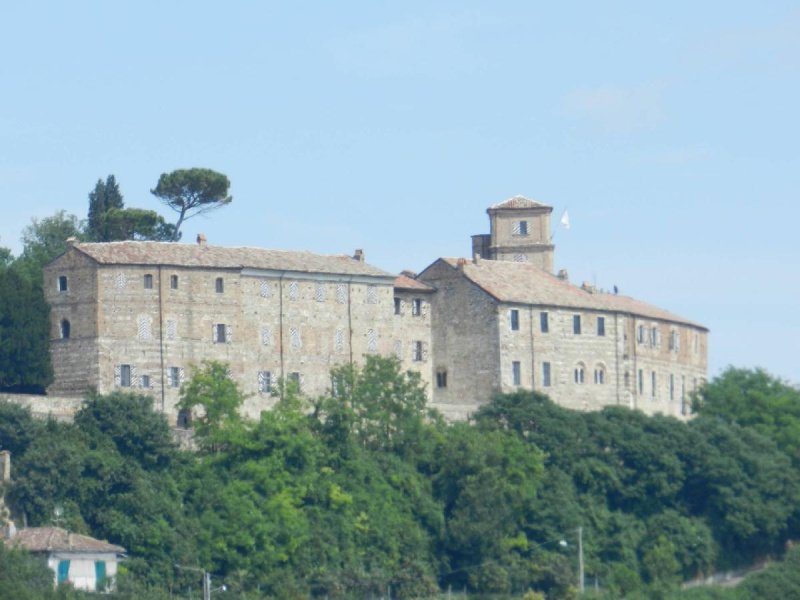
The castle of Montiglio continues to dominate with its size the village and the Hill on which it stands featuring the profile at a great distance. The current building, with irregular, elongated L shape, is the remaining part of a more complex structure that had U-plan: keep the Center and upper body stretching in front of the South front, up to the building that now stands isolated at the Southwest end of courtyard.
This plant, which makes the most of defensive capabilities of the site corresponds to the medieval. Main bastionated face was probably added in the 16th century. Eighteenth-century relief highlights the unique shape of the fortress, composed of structurally independent towers aggregate as granting the maximum efficiency for the purpose of Defense.
In the curtain wall from Nice weaving draped the four houses still exist today and merged, tans the ancient battlements ghibelline and louvers swabbed. In the first, starting from the East two large mullioned Windows with small pillars illuminate a large Salon. In the four houses stand-level compartments are covered with barrel vaults, the upper ones from wooden floors.
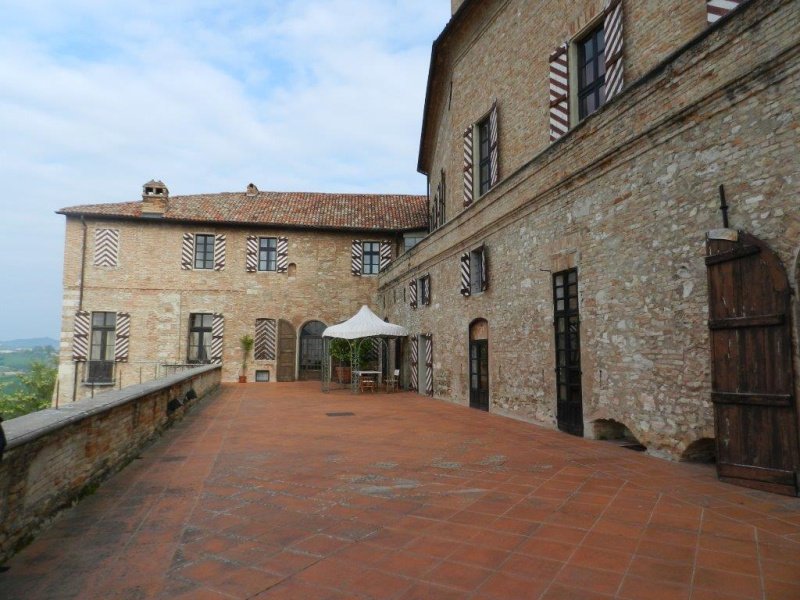
Initially organized on three levels above ground and fortified by a strong city walls, the castle of Montiglio suffered substantial interventions in the 18th century, especially at the top of the wing to the Northwest, giving the Manor residential with dignity creating a staircase, an elegant arched Salon dilated from fake quadrature, a terrace surmounted by a tower, a porch that opens to the garden to the North, where hedges and plants of lauro ceraso draw a charming maze. Large wineries turn came around the same time equipped for the production and storage of wine.
In the small chapel, dedicated to St Andrew and Gaudenzio, a 14th-century frescoes.
6,000 sqm. tallest building in the Park.
Taal van waaruit de automatische vertaling is gegenereerd
Il castello di Montiglio continua a dominare con la sua mole il paese e la collina su cui sorge caratterizzandone il profilo a grande distanza. L'attuale edificio, con pianta a L irregolare e allungata, è la parte residua di una più complessa struttura che aveva pianta a U: dongione al centro e avancorpo che si estendeva davanti al fronte sud, fino alla costruzione che oggi sorge isolata alla estremità sud-ovest del cortile.
Tale impianto, che sfrutta al meglio le possibilità difensive del sito, corrisponde a quello medioevale. Il fronte bastionato fu invece aggiunto con ogni probabilità nel XVI secolo. Il rilievo settecentesco evidenzia la particolarissima conformazione del fortilizio, composto da torri strutturalmente indipendenti aggregate secondo la disposizione che garantiva la massima efficienza ai fini della difesa.
Nella cortina muraria dalla bella tessitura listata delle quattro case-torri ancora oggi esistenti e accorpate, si palesano le antiche merlature ghibelline e le feritoie tamponate. Nella prima, a partire da est due ampie bifore con colonnine illuminano un vasto salone. Nelle quattro case-torri i vani a livello del basamento sono coperti da volte a botte, quelle superiori da solai lignei.
Inizialmente organizzato su tre livelli sopra il terreno e fortificato da una robusta cinta muraria, il castello di Montiglio subì nel XVIII secolo notevoli interventi, specie nella parte superiore dell'ala a nord-ovest, conferendo al maniero dignità residenziale con la creazione di uno scalone, un elegante salone ogivale dilatato da finte quadrature, un terrazzo sovrastato da una torre, un portico che si apre sul giardino a nord, dove siepi di bosso e piante di lauro ceraso disegnano un suggestivo labirinto. Le grandi cantine voltate vennero nello stesso periodo attrezzate per la produzione e conservazione del vino.
Nella piccola cappella, dedicata ai santi Andrea e Gaudenzio, è conservato un ciclo di affreschi trecentesco.
6.000 mq. edificio più parco.
Die Burg von Montiglio weiterhin mit seiner Größe zu beherrschen, das Dorf und die Hügel, auf dem es steht mit dem Profil in großer Entfernung. Das heutige Gebäude, mit unregelmäßigen, länglichen L-Form, ist der verbleibende Teil einer komplexeren Struktur, die U-Plan hatte: die Center und Oberkörper dehnen vor der Süd-Front zu halten, bis das Gebäude steht, dass jetzt isoliert am Südwest-Ende des Hof.
Diese Pflanze, wodurch die meisten defensiven Fähigkeiten des Standortes entspricht der mittelalterlichen. Wichtigsten Bastionated Gesicht wurde wahrscheinlich im 16. Jahrhundert hinzugefügt. 18. Jahrhundert Relief unterstreicht die einzigartige Form der Festung, bestehend aus strukturell unabhängige Türme Aggregat als Gewährung den maximalen Wirkungsgrad zum Zwecke der Verteidigung.
In der Fassade aus schöne weben drapiert die vier Häuser noch gibt es heute und zusammengeführt, bräunt der alten Festungsmauer Ghibelline und Luftschlitze geschrubbt. In der ersten ausgehend von der Osten zwei große zweibogigen Fenster mit kleinen Säulen beleuchten einen großen Salon. In den vier Häusern fallen Bestandesebene Fächer mit Tonnengewölbe, die oberen, die von Holzböden.
Zunächst auf drei Ebenen oben geschliffen und gestärkt durch einen starken Stadtmauern organisiert, erlitt die Burg Montiglio erhebliche Eingriffe im 18. Jahrhundert, vor allem an der Spitze des Flügels im Nordwesten, das Herrenhaus wohnen mit würde zu geben erstellen eine Treppe, ein elegantes gewölbt Salon von gefälschten Quadratur, überragt von einem Turm, eine Veranda, die zum Garten im Norden öffnet wo Hecken und Pflanzen von Lauro Ceraso ein bezauberndes Labyrinth zeichnen Terrasse erweitert. Große Weingüter Wende kam etwa zur gleichen Zeit, die für die Produktion und Lagerung von Wein ausgestattet.
In der kleinen Kapelle zu Ehren von St. Andrew und Gaudenzio Fresken ein 14. Jahrhundert.
6.000 qm. das höchste Gebäude im Park.
Le château de Montiglio continue à dominer grâce à sa taille, le village et la colline sur laquelle il mettant en vedette le profil à une grande distance. Le bâtiment actuel, avec la forme irrégulière et allongée L, est la partie restante d'une structure plus complexe qui avait U-plan : garder le centre et la partie supérieure du corps qui s'étend devant la façade sud, jusqu'à la construction que maintenant se dresse isolée à l'extrémité sud-ouest du Cour intérieure.
Cette plante, qui exploite au maximum des capacités de défense du site correspond à la médiévale. Visage bastionated principale a été probablement ajouté au XVIe siècle. Soulagement du XVIIIe siècle met en valeur la forme unique de la forteresse, composée de tours structurellement indépendants globales comme donnant le maximum d'efficacité aux fins de la défense.
Dans le mur rideau depuis Nice tissage drapé quatre maisons encore existent aujourd'hui et fusionnent, bronze antiques créneaux gibelins et persiennes frottées. Dans le premier, à partir de l'Orient deux grandes fenêtres jumelées avec petits piliers s'allument, un grand Salon. Dans les maisons de quatre compartiments de peuplement sont recouverts de voûtes, celles supérieures de planchers en bois.
Initialement organisée sur trois niveaux supérieurs au sol et de fortifié par une forte de remparts, le château de Montiglio a subi des interventions importantes au XVIIIe siècle, surtout dans la partie supérieure de l'aile vers le Nord-Ouest, en donnant le manoir résidentiel avec dignité création d'un escalier, un élégant arqué Salon dilaté de faux en quadrature, une terrasse surmontée d'une tour, un porche qui s'ouvre sur le jardin au nord, où les haies et les plantes de lauro ceraso dessiner un labyrinthe charmant. Grandes caves tour est venu à la même époque, équipée pour la production et le stockage du vin.
Dans la petite chapelle, dédiée à Saint-Andrew et Gaudenzio, un 14ème siècle fresques.
6 000 m². plus haut bâtiment dans le parc.